Author: heydanajane

  • The Great Thermostat War: A Tale of Hot Flashes and Frostbite

    Marriage is about love, compromise, and, apparently, waging all-out war over the thermostat.

    For years, The Huz and I lived in perfect(ish) harmony, mostly agreeing on things like where to eat and how to fold towels (his method is wrong, but I let it slide). Then, perimenopause hit. And with it, an unrelenting inferno of hot flashes that turned our home into a battlefield.

    The Climate Crisis at Home

    Let me set the scene: It’s February. Outside, it’s a crisp 10 degrees, snow is gently falling, and inside, I am melting like a candle in a microwave. My body has decided that I am a human furnace, and I am radiating heat like the sun. So naturally, I do what any overheated, slightly unhinged woman would do—I set the thermostat to a reasonable 65 degrees.

    Enter my husband, shivering like a Dickensian orphan.

    “Why is the thermostat set at 65 degrees in February?!” he exclaims, rubbing his hands together for warmth, probably contemplating layering a third sweatshirt over his already fleece-lined existence.

    Without missing a beat, I turn to him, eyes wild, sweat glistening on my brow, and declare:
    “Touch that dial and you can heat your ass in Hell!”

    A Marriage Built on Compromise (But Not This Time)

    Now, in any normal marital disagreement, we would find a middle ground. But there is no middle ground when one person is living inside the core of the Earth while the other is actively developing frostbite.

    We have tried:
    ✔️ Blankets (he’s wrapped up like a burrito while I lay sprawled out like a starfish).
    ✔️ Heated socks (for him—while my bare feet enjoy the icy bliss of the fan blowing next to me).
    ✔️ A space heater (which he positions near his side of the bed while glaring at me like I’m his personal Arctic tormentor).

    Nothing is working. My only recourse is to maintain my dominion over the thermostat, defending it like a dragon hoarding gold.

    Creative Solutions (That Mostly Favor Me)

    My husband, desperate, has suggested a separate climate-controlled bedroom—basically a marital igloo just for him. I suggested that instead, he embrace his inner Viking and toughen up. He was not amused.

    We are now at an impasse. The thermostat remains at 65. He remains layered like he’s about to summit Everest. And I remain victorious… for now.

    The Moral of the Story

    Marriage is about love, laughter, and respecting each other’s needs. But also, and perhaps more importantly, it’s about not touching the damn thermostat.

    Stay warm (unless you’re me, in which case, stay chilled to perfection).

  • Drowning in Denial: Loving Someone Who Won’t Save Themselves

    It’s a strange kind of grief—watching someone you love slowly destroy themselves, knowing that no matter how much you plead, beg, or cry, they won’t change. Not because they can’t, but because they won’t. Because the bottle is easier. Because the pain is numbed just enough to make tomorrow seem bearable, even if it means drowning today.

    You tell yourself it’s a disease. You remind yourself of that every time they make promises they won’t keep. Every time they slur their words through another excuse. Every time they look you in the eyes and swear they’ll do better, but the next weekend, they’re right back where they started. You know addiction is powerful, but what you don’t understand—what keeps you up at night—is why they don’t seem to want to fight it. Why they won’t even try.

    And maybe the worst part is that they think they’re fooling you. They act like they have it under control, like their drinking isn’t a problem as long as they still go to work, pay their bills, and function just enough to pretend everything is fine. But you see the cracks. The way their hands shake in the morning. The way their personality shifts, sharp and defensive, when you bring it up. The way they push you away, either because they don’t want to hear the truth or because deep down, they know they’re failing you, and it’s easier to resent you than to face themselves.

    You remember the person they used to be. The one who laughed with you, who had dreams and plans, who cared. And you wonder if that person is still in there somewhere, buried beneath the layers of liquor and denial. You wonder if they ever think about getting better, if they ever wake up and realize what they’re losing. What they’ve already lost.

    But the hardest part—the part that breaks you over and over—is knowing that no matter how much you love them, no matter how much you want to save them, you can’t. Because they don’t want to be saved. And until they do, you’re just standing on the shore, watching them drift farther and farther away, screaming into the wind, knowing they can hear you but choosing not to listen.

  • Grandma Alice’s Farmhouse

    The farmhouse stood tall, its brick walls holding generations of laughter and love. The porch was a place for whispered dreams, where summer breezes carried the scent of wildflowers and fresh-cut hay. Inside, the floors creaked with the weight of footsteps both past and present, and the kitchen was always warm, filled with the comforting smells of home-cooked meals.

    Through bright summers and harsh winters, the house remained, a constant presence against the ever-changing world. It was more than just a building; it was a keeper of stories, a witness to childhood adventures and quiet moments of reflection.

    Then, one day, fire took it away. The walls crumbled, the memories held in wood and stone reduced to ash. But no flame could erase the love it once sheltered. The farmhouse still stands, not in fields of green, but in the heart of those who loved it. And there, it will remain—untouched by time, forever home.

  • Dysfunction in Crisis: The Caretaker’s Burden and the Path to Freedom

    Crisis reveals everything. It strips away the everyday distractions and exposes the mechanics of a dysfunctional family in stark relief. When disaster strikes—an illness, a death, an addiction spiraling out of control—everyone assumes their role like a well-rehearsed play.

    The Martyr drowns in their suffering, making sure everyone sees their pain.
    The Denier pretends nothing is wrong, keeping up appearances at all costs.
    The Scapegoat absorbs the blame, cast as the family’s eternal problem.
    And then there’s the Caretaker—me, maybe you—the one who holds it all together.

    We are the steady hands that wipe tears, the calm voices that diffuse tension, the planners, the peacemakers, the ones who set our own needs aside so everyone else can function. We step up before anyone even asks because we have always been the ones to fix, to manage, to endure.

    But here’s the truth no one tells you: the Caretaker breaks, too.

    We don’t shatter in obvious ways. We don’t scream or slam doors. Our fractures appear in the quiet—exhaustion that seeps into our bones, resentment we swallow before it can surface, the loneliness of being the one who carries everything while no one carries us.

    And yet, we keep going. Because who else will?

    The Lie We Believe

    The biggest deception of the Caretaker role is that we must continue at all costs. That without us, everything falls apart. That our worth is measured in how much we can endure.

    But let me ask you something—when was the last time someone cared for you? When was the last time you let them?

    The truth is, dysfunction thrives when roles never change. And healing begins when one person decides to break the pattern.

    A New Way Forward

    If you are the Caretaker, I want you to know this: you do not have to save everyone. You are allowed to step back. You are allowed to rest. You are allowed to say, I need help, too.

    Maybe that starts small—saying no to a responsibility that isn’t yours, letting someone else manage their own emotions instead of absorbing them, asking for support instead of assuming no one will give it.

    Maybe it means reminding yourself, daily, that love is not measured in sacrifice alone. That your needs are not burdens. That the people who truly love you will not disappear when you stop being their fixer.

    Hope for the Weary

    There is a life beyond being the caretaker. A life where you are not just holding everyone else together but living fully, deeply, for yourself. It won’t be easy. The people who have relied on you to be their constant may resist. But you were never meant to be the foundation of someone else’s survival.

    You deserve peace. You deserve care. You deserve a love that nurtures you, not just one that takes.

    Step back. Breathe. Let the world spin without you holding it up for a while. It will keep turning. And you? You will finally be free.

  • The Fragile Things We Nurture

    The dream lingered with me long after I woke, its weight pressing against my chest like the tiny, fragile body of the starving puppy I had cradled in my sleep. In the dream, I found it—weak, trembling, on the edge of life—somewhere within the familiar walls of my home. Its ribs jutted out beneath a matted coat, its eyes dull with exhaustion, but even in its desperate state, it had looked at me with trust. I couldn’t ignore it. I couldn’t turn away. So, I scooped it up, wrapping it in warmth, offering it food, water, comfort. Slowly, it revived. Day by day, it grew stronger under my care, its tail beginning to wag, its eyes regaining their light. Love, patience, and tenderness brought it back from the brink.

    When I woke, I couldn’t shake the feeling that the dream meant something more. A quick search for dream analysis suggested that the puppy symbolized something—or someone—in my life that needed care and nurturing. And suddenly, it made sense.

    The night before, I had sat in the sterile, beeping quiet of a hospital room, watching my mother battle against the cruel complications of cancer. I had held her hand, spoken to her in gentle tones, adjusted her blanket when she shivered. She was the one now so fragile, so weak, caught between exhaustion and survival. And I, helpless in so many ways, could only offer my presence, my love, my care.

    Maybe my subconscious was telling me what I already knew deep down: that this season of my life is about giving—of patience, of strength, of love—no matter how heavy it feels. And just like in the dream, all I can do is nurture, tend, and hope that, somehow, it will be enough.

  • The Innocence of a Child’s Prayer

    There is a purity in a child’s prayer that can soften even the heaviest of hearts. It isn’t weighed down by doubt, overcomplicated by adult reasoning, or hindered by pride. It is simple, honest, and full of trust.

    Last night, as my mom lay in a hospital bed—her body fighting the cruel complications of cancer, possibly even a transient ischemic attack—my son, Gannon, wanted to pray for her. I watched as he folded his hands, made the sign of the cross, and began to speak:

    “Dear God, we ask you to help Grandma and make her well. Anything you can do is appreciated. We ask this in Jesus’s name, Amen.”

    That was it. No long-winded pleas, no desperation masked in complex words—just a child’s heart speaking plainly to God. And it was enough.

    As I listened, I felt something stir deep within me. Humility. Hope. A reminder of faith unshaken by life’s hardships. Gannon wasn’t worried about saying the right thing or making sense of all the fear and uncertainty. He just asked, believing that God would hear.

    Tears welled in my eyes as he ended with the sign of the cross, sealing his words with sincerity. In that moment, I was reminded just how special children are. They show us what it means to trust without hesitation, to love without limits, and to pray without doubt.

    I don’t know what the coming days will bring, but I do know this—God hears the prayers of children. And maybe, just maybe, that’s all the faith we need.

  • Green & Gold: A Love Letter to Wisconsin, Family, and Football

    There are movies that entertain, movies that inspire, and then there are movies that take root in your soul. Green & Gold is one of those movies.

    Gannon and I saw it yesterday on opening weekend, and from the very first scene, I knew I was about to witness something special. A story about the humble, hardworking, God-fearing farming communities of Wisconsin—woven together with the deep, unwavering love for the Green Bay Packers—was bound to be emotional. But I wasn’t prepared for just how deeply it would resonate with me.

    Sitting in that dark theater, memories of my childhood came rushing back, so vivid I could almost smell the fresh-cut hay. I was back on my grandma’s farm, watching my Uncle Pauly deliver a calf—his arm buried up to his shoulder to help bring new life into the world. I could feel the rough twine of hay bales in my hands, the weight of them just a little too much for my small arms to lift. I saw myself, cautiously walking the aisle of the old barn, petting the heads of the Holsteins, naming them—Bessie, Bossy, Lulu, Buttercup—just like Craig T. Nelson’s character, Buck, named his cows after the 1968 Packers Championship team.

    I thought of my Grandma Alice, how fiercely my family cared for her after her stroke, how we did everything we could to keep her home, safe, and surrounded by love. When Jenny’s grandma had an accident on the farm, the ache in my heart was real. I knew that story.

    And then came the real-life footage of the 1992 Green Bay Packers. Brett Favre, the Gunslinger. Sterling Sharpe. LeRoy Butler. John Jurkovic. Chris Jacke. The icons of my childhood, the voices of my dad and siblings echoing in my memory as we watched those games together. I had goosebumps reliving that era, the golden days of Sundays spent in front of the TV, where wins felt like magic and losses felt personal.

    Craig T. Nelson embodied the kind of Wisconsin man I’ve known my whole life—the hardworking dairy farmer who loves God, his land, his family, and his neighbors. A man whose word is his bond, whose hands are rough from labor but gentle with his children. A man who always does the right thing, even loving his enemy.

    And then there was Jenny—played so beautifully by Madison Lawlor. A girl growing up on a farm, knowing the work never ends, but still daring to dream of something more. I was Jenny. I understood the exhaustion, the longing, the pride. The way your roots never really let go of you, even when you reach for something beyond the fields.

    As the credits rolled, I wiped my tears, turned to Gannon, and asked, “What did you think?”

    “This is the greatest movie ever,” he said.

    I nodded, my throat tight. It’s the Wisconsin, football, farming version of Field of Dreams, I thought.

    And let’s not forget the voice of Charlie Berens, carrying through the film like a thread tying past and present together. It stirred something else inside me—a reminder of Bob Uecker, the voice of my childhood, the sound of sports radio humming in the background of my life. It made me realize, maybe more than ever, how proud I am to be from Wisconsin. To have farming in my blood, to be part of a community that shows up for each other, to wear green and gold like a badge of honor.

    Gannon was right. Best movie ever. Go see it. And Go, Pack!

  • Donald Trump is Not Jesus: Why Do Conservatives Worship Him as a Savior?

    Let’s get one thing straight: Donald Trump is not Jesus. I know, shocking, right? Yet somehow, a staggering number of conservatives have elevated him to a near-messianic status. As someone who grew up with a basic understanding of Christianity, this belief both fascinates and shocks me. How does a thrice-married billionaire, who openly bragged about his sins on live TV, become the anointed one for people who claim to follow the teachings of a humble carpenter from Nazareth?

    I’m genuinely perplexed. How do devout Christians—who, I assume, own Bibles—justify putting Trump on such a high pedestal? Is it his policies? His charisma? His tan? What is it about this man that inspires slogans like “Jesus is my Savior, Trump is my President”?

    The Savior Complex
    One explanation lies in the rise of Christian nationalism, which marries American identity with Christian doctrine. Some believers genuinely see Trump as divinely chosen, a flawed but God-ordained leader sent to protect the nation. It’s as if they flipped through the Bible and decided he’s this era’s King David—ignoring the part where David repented.

    But does Trump himself fuel this narrative? Absolutely. He courts it. Whether it’s holding a Bible (upside down, no less) in front of a church or using buzzwords like “religious liberty,” he knows exactly how to speak to a crowd that wants a savior, not just a president.

    The Defender of Values (or at Least Some of Them)
    Here’s where it gets even trickier. Many of Trump’s biggest supporters view him as a warrior fighting against the so-called “war on Christianity.” They see him as the protector of religious freedom, the bulldozer of secularism, and the architect of a morally upright Supreme Court. For some, it’s not about his personal faith—it’s about the results he delivers.

    But isn’t there a line? At what point do principles outweigh politics? If the ends always justify the means, what does that say about the values being protected?

    Cult of Personality Meets the Cross
    It’s impossible to ignore the cult of personality surrounding Trump. He embodies their frustrations, fears, and aspirations in a way that feels deeply personal. He’s not just a politician; he’s their champion, their fighter, their chosen one. And in an age where social media amplifies every word, gesture, and soundbite, it’s easy for a leader to transcend politics and become something much bigger.

    But bigger than Jesus? Really?

    Let’s Think About This
    I’m not here to question anyone’s faith. But I do wonder: How did we get here? How did a religion that preaches humility and compassion become so intertwined with a political figure who, by all accounts, thrives on pride and division? And more importantly, what happens when the “savior” fails to deliver?

    Donald Trump is not Jesus. He’s not even John the Baptist. And maybe it’s time for some self-reflection: Are we worshiping the message, or are we worshiping the man?

    Because last I checked, there’s only room for one savior in Christianity—and he’s not running for president.

  • Work, Food, and Perspective: My Trip to Austin

    After a short break from the blog, I’m back! I spent the past few days traveling to Texas for work, flying into Austin for a conference with two colleagues. The trip itself was mostly smooth, except for one unsettling moment—mid-flight, a man seated across the aisle began having seizures. The flight attendants quickly jumped into action, and an announcement was made asking for any doctors or nurses on board. Thankfully, a nurse in first class was able to assist him until we landed, where paramedics were waiting at the gate. It was a scary situation to witness, but I was relieved to hear he was okay.

    Conference by Day, Relaxation by Night

    The conference itself was productive—long days filled with sessions and networking. But while my colleagues ventured out for beers after dinner, I found myself retreating to my hotel room, book in hand, flipping through TV reruns, and falling asleep early… three nights in a row. When did I become the person who prefers silence over socializing? Maybe it’s just the reality of parenthood—when no one is yelling “Mom!” every ten seconds, the quiet feels like a luxury.

    A Culinary Adventure

    One of the highlights of any trip to Austin is the food, and this visit did not disappoint.

    • Sunday Night: I took my colleagues to Moonshine Grill, a favorite from a previous trip. This time, I tried the horseradish-encrusted salmon with crispy Brussels sprouts—absolute perfection. My teammates indulged in street corn queso, blackened catfish, and chicken & waffles, and they loved every bite.
    • Monday Night: We hit up Terry Black’s Barbecue, a staple in Austin. We devoured ribs, brisket, and green beans. Lucas ordered a beef rib so massive, we joked it was the size of a child’s femur. I stuck to the pork ribs, which were fall-off-the-bone delicious.
    • Tuesday Night: Our final dinner was at Pinthouse Brewing, and wow—this place was a winner. I tried their cider and hard kombucha (both fantastic), but the food was next level. The wagyu burger was hands down the best I’ve had, and the sourdough pizza was an unexpected delight. Safe to say, we’ll be dining here again when we return next month.

    Gratitude & Perspective

    After a whirlwind few days, I was more than ready to be home on Wednesday. Travel always makes me grateful for the pilots and crews who get us safely from one place to another. That gratitude hit even harder the next morning when I woke up to the devastating news of a mid-air collision between an American Airlines plane and a military helicopter at Reagan International Airport in Washington, D.C. It was heartbreaking to hear of the lives lost. Moments like these remind me how fragile life is and why we should never take it for granted. My heart goes out to those grieving their loved ones.

    This trip was full of work, good food, and quiet reflection. And as much as I love traveling, there’s nothing like coming home.

    Moonshine Grill, downtown Austin
    Terry Black’s Barbecue, downtown Austin
    Pinthouse Brewing, Austin, TX
  • The Road to Grown

    The road from kindergarten to senior year is wild and unrelenting, a blur of milestones and moments that feel too big and too small all at once. One day, you’re tying their shoes, and the next, you’re watching them drive away, their world expanding while yours grows quieter. It’s thrilling and devastating all at the same time.

    You cheer them on, of course. You want them to grow, to thrive, to become everything they’re meant to be. That’s the job. You celebrate their victories, no matter how small—a finger-painted masterpiece, a first home run, a college acceptance letter. But in the quiet, when no one’s looking, you ache. You ache for the tiny hand that used to slip into yours without hesitation. You ache for the bedtime stories and the giggles over nothing. You ache for the version of them that still needed you for everything.

    And yet, here they are, needing you less every day. You’re proud of them, so proud it feels like your chest might burst, but the pride comes with a hollowing-out, a slow surrender to the fact that they’re not yours to keep. They never were. They’re only borrowed, these beautiful, messy, miraculous little humans.

    You try not to let it show. You focus on the joy—their first dance, their first job, their first steps into the world without you. You tell yourself this is what it’s all for, and it is. But some nights, when the house is too quiet and the memories creep in, you’d give anything to go back. Just for a little while. To kiss their scraped knees, to hear them call for you in the night, to hold them close and feel like their whole world again.

    It’s the sweetest agony, watching them grow up. You wouldn’t trade it for anything, but if you’re honest, you’d keep them small just a little longer if you could.

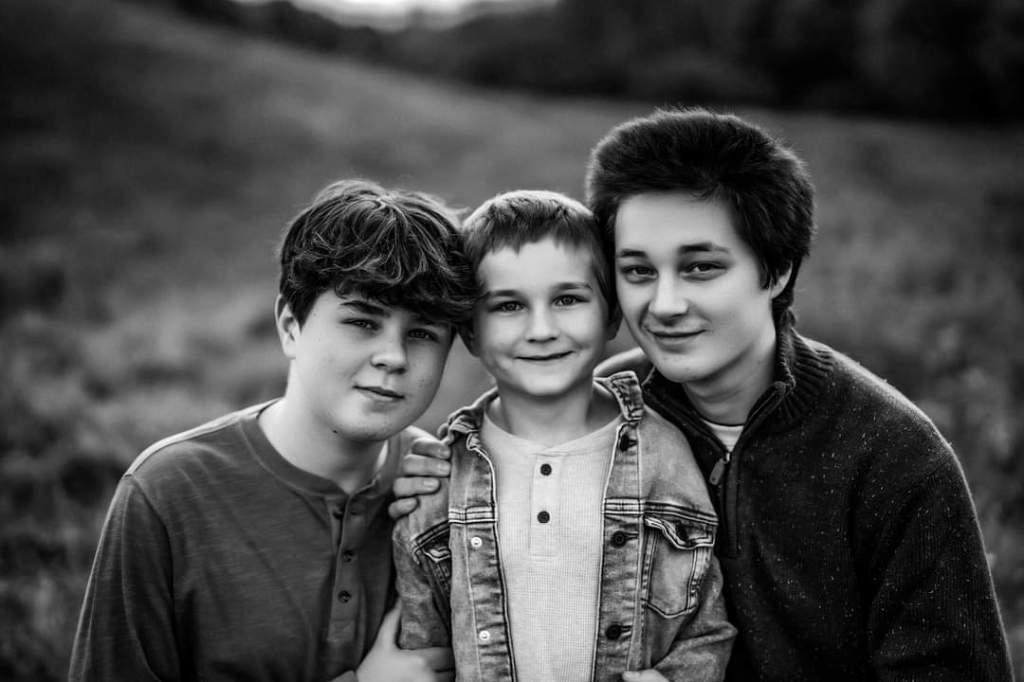
    One of my favorite images from our family portrait session by Ashley Herek Photography.