In a world where social media can amplify both faith and folly, the story of Laire Lightner has been nothing short of remarkable, and concerning. It all began with a simple Facebook post, a plea for prayers for her son, Franky, who was tragically declared brain dead following a motorcycle accident. As concerned individuals, many of us joined her virtual congregation, offering support and prayers, believing in the power of collective goodwill.
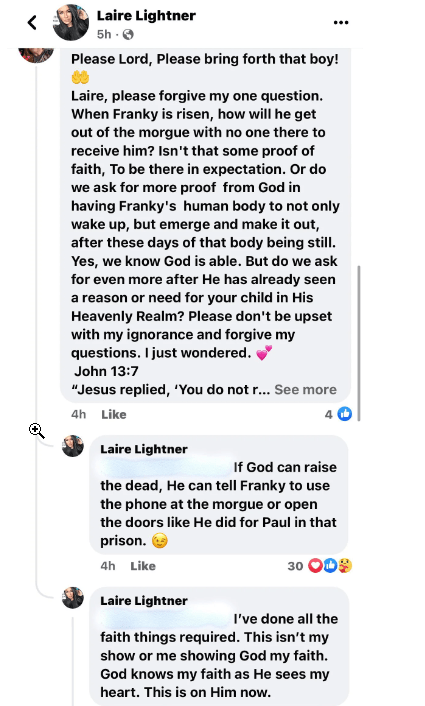
However, what initially appeared to be a mother’s desperate cry for help gradually took a strange turn. Laire began asserting that she was a prophet, chosen by God to convey divine messages. Red flags started waving wildly when she claimed that Jesus would resurrect her son, much like Lazarus. She declared that God instructed her to remove Franky from life support, and he passed away just minutes later. The subsequent narrative involved Franky’s body remaining in the morgue for three days, awaiting a resurrection that never occurred. Instead, Laire spun a tale of Franky choosing to stay in Heaven with Jesus, a decision she claimed she anticipated.
The core of the issue lies in Laire’s brand of Christianity, which appears to align with the New Apostolic Reformation. This movement is notorious for blurring the lines between biblical teachings and non-biblical interpretations. Laire’s approach to prayer, for instance, deviates significantly from traditional Christian understanding.
Historically, prayer has been about making humble petitions to God, seeking His will and guidance. Laire, on the other hand, uses the term “prayer” to mean something entirely different. She doesn’t request or ask; instead, she declares what God will do, attempting to bring her desired reality into existence through spoken affirmations. In this misinterpretation, she veers into dangerous territory, seemingly believing that her words possess the power to create, a notion inconsistent with traditional Christian doctrine.
What’s truly alarming is that Laire has amassed hundreds of thousands of followers who mimic her beliefs and practices. This could lead to a distortion of biblical teachings and a dangerous misunderstanding of the power of faith. When her declaration of resurrection did not happen, she questions how she could have possibly “gotten it wrong.” She feels strongly that God speaks to her as a prophet, and cannot comprehend that she is wrong.
Even more concerning is the reaction to dissenting voices. Anyone daring to question Laire’s beliefs is met with a barrage of attacks, harassment, and even blocks. She has gone as far as to contact publishers and demand that they distance themselves from individuals who criticize her. But what really concerns me is her post that calls for a curse, in God’s name, to fall upon any of her detractors (see images below). This sort of behavior not only stifles healthy discourse but also raises questions about the authenticity of the movement she represents.
While our hearts undoubtedly ache for the Lightner family in their time of tragedy, it is impossible to ignore the unsettling truth that they have been led down a path of questionable theology. Franky’s death is undeniably tragic, but the refusal to acknowledge the glaring issues with their beliefs and practices is perhaps even more distressing.
In a world where faith and social media collide, the case of Laire Lightner serves as a stark reminder of the importance of discernment and the dangers of unchecked influence. Let us hope that, in time, they find solace and clarity amidst the tumultuous currents of their belief system.


 Hey Dana Jane
Leave a comment