Tag: Religion

  • Backwards or Traditions Reclaimed? A Woman’s Take on the American Catholic Church

    I love my Catholic faith. The teachings of Christ, the sacraments, the sense of community—it’s deeply woven into the fabric of who I am. But loving something doesn’t mean you don’t question it or call it out when necessary. And lately, I’ve found myself wrestling with something troubling: a seemingly growing movement within the American Catholic Church to return to “old” traditions, particularly when it comes to women.

    I’ve seen women donning veils in Mass and receiving communion exclusively on the tongue, and I can’t help but feel that this marks a step backward. Let me be clear: I don’t have an issue with women who choose to practice their faith in this way. If wearing a veil makes someone feel closer to God, or if receiving communion on the tongue deepens their reverence, that’s beautiful. Faith is personal, and everyone’s journey is unique.

    What I do have a problem with is the undercurrent of manipulation, guilt, or outright judgment from some corners of the Church, suggesting that if you don’t conform to these “traditional” practices, your faith is somehow lacking. That, as a woman, my way of practicing Catholicism must look like it did a century ago. To that, I say no.

    The Catholic Church has a long history of oppressing women—limiting our voices, marginalizing our contributions, and sometimes even blaming us for the Church’s shortcomings. I refuse to be guilted, forced, or shamed into a role that feels archaic, subservient, and disconnected from my identity. Women are not the lesser sex, and we don’t need to hide behind veils to prove our holiness.

    This isn’t just my personal frustration; it’s a systemic issue. The Church is, ultimately, an organization dominated by men. And often, those men are flawed. Power-hungry. Sometimes narcissistic. And let’s not forget the scars left by the abuse scandal. Many of us—myself included—are still reeling from it, struggling to reconcile the faith we love with the institution that failed so profoundly to protect its people.

    It’s not easy being Catholic in America today. There’s a growing divide between tradition and progress, and too often, women are caught in the middle. When women feel unheard or oppressed within the Church, they leave. And when they leave, they take their children with them. That’s why pews are emptier now than in years past.

    So, to the leaders of the Church, I ask: Are we so fixated on reclaiming the past that we’re willing to lose the future?

    I will always love my faith. But loving my faith doesn’t mean I have to agree with everything about the Church. It’s okay to question, to push back, to demand better. Because if the Church truly wants to thrive in the modern world, it needs to recognize that women are not relics of the past. We are the present, and we deserve a faith that honors our dignity, intelligence, and contributions—not one that tries to veil them.

  • The Curious Case of Laire Lightner: A Self-Proclaimed Prophet’s Unsettling Claims

    The Curious Case of Laire Lightner: A Self-Proclaimed Prophet’s Unsettling Claims

    In a world where social media can amplify both faith and folly, the story of Laire Lightner has been nothing short of remarkable, and concerning. It all began with a simple Facebook post, a plea for prayers for her son, Franky, who was tragically declared brain dead following a motorcycle accident. As concerned individuals, many of us joined her virtual congregation, offering support and prayers, believing in the power of collective goodwill.

    However, what initially appeared to be a mother’s desperate cry for help gradually took a strange turn. Laire began asserting that she was a prophet, chosen by God to convey divine messages. Red flags started waving wildly when she claimed that Jesus would resurrect her son, much like Lazarus. She declared that God instructed her to remove Franky from life support, and he passed away just minutes later. The subsequent narrative involved Franky’s body remaining in the morgue for three days, awaiting a resurrection that never occurred. Instead, Laire spun a tale of Franky choosing to stay in Heaven with Jesus, a decision she claimed she anticipated.

    The core of the issue lies in Laire’s brand of Christianity, which appears to align with the New Apostolic Reformation. This movement is notorious for blurring the lines between biblical teachings and non-biblical interpretations. Laire’s approach to prayer, for instance, deviates significantly from traditional Christian understanding.

    Historically, prayer has been about making humble petitions to God, seeking His will and guidance. Laire, on the other hand, uses the term “prayer” to mean something entirely different. She doesn’t request or ask; instead, she declares what God will do, attempting to bring her desired reality into existence through spoken affirmations. In this misinterpretation, she veers into dangerous territory, seemingly believing that her words possess the power to create, a notion inconsistent with traditional Christian doctrine.

    What’s truly alarming is that Laire has amassed hundreds of thousands of followers who mimic her beliefs and practices. This could lead to a distortion of biblical teachings and a dangerous misunderstanding of the power of faith. When her declaration of resurrection did not happen, she questions how she could have possibly “gotten it wrong.” She feels strongly that God speaks to her as a prophet, and cannot comprehend that she is wrong.

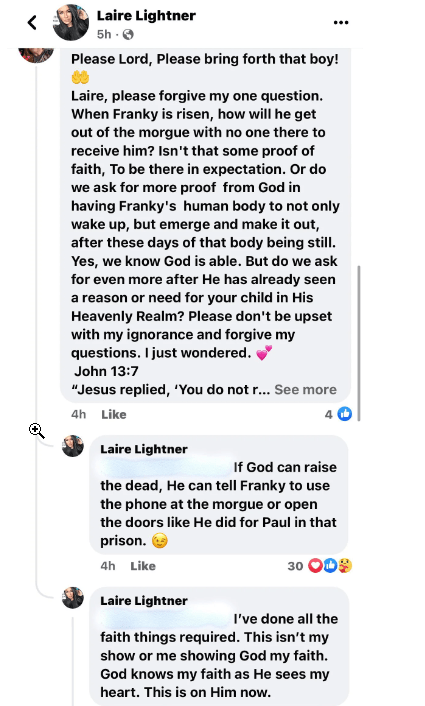
    Even more concerning is the reaction to dissenting voices. Anyone daring to question Laire’s beliefs is met with a barrage of attacks, harassment, and even blocks. She has gone as far as to contact publishers and demand that they distance themselves from individuals who criticize her. But what really concerns me is her post that calls for a curse, in God’s name, to fall upon any of her detractors (see images below). This sort of behavior not only stifles healthy discourse but also raises questions about the authenticity of the movement she represents.

    While our hearts undoubtedly ache for the Lightner family in their time of tragedy, it is impossible to ignore the unsettling truth that they have been led down a path of questionable theology. Franky’s death is undeniably tragic, but the refusal to acknowledge the glaring issues with their beliefs and practices is perhaps even more distressing.

    In a world where faith and social media collide, the case of Laire Lightner serves as a stark reminder of the importance of discernment and the dangers of unchecked influence. Let us hope that, in time, they find solace and clarity amidst the tumultuous currents of their belief system.

  • The Art of Forgiveness: A Journey Unique to Each Soul

    Forgiveness is a profound and transformative act that holds the power to heal wounds, mend broken relationships, and release the heavy burden of resentment. It is an intricate and deeply personal journey that cannot be rushed or forced upon anyone. Instead, forgiveness is a delicate art, a process as unique as the individuals who embark upon it. In my own journey toward spiritual growth, the topic of forgiveness comes up often. It has taken a lot of introspection and self-awareness for me to forgive those who have hurt me, whether they have asked for it, or not.

    In the vast tapestry of human emotions, forgiveness stands as a beacon of hope and reconciliation. It is a gift we give not only to others but also to ourselves, freeing our hearts from the chains of anger and bitterness. While it may be a universal concept, the path to forgiveness is anything but one-size-fits-all. Each person’s experience with forgiveness is as distinct as their fingerprints, shaped by their life experiences, values, and the depth of their emotional wounds.

    Forgiveness, to humans, generally means the act of letting go of negative feelings, resentment, or the desire for revenge toward someone who has wronged them. It involves a willingness to pardon or excuse the actions of another person and to release the emotional burden associated with the hurt or offense. Forgiveness can have several important meanings and benefits for individuals:

    1. Emotional Healing: Forgiving someone can help individuals heal from emotional pain and trauma, promoting their own mental and emotional well-being.
    2. Reconciliation: In some cases, forgiveness can lead to reconciliation and the restoration of relationships.
    3. Inner Peace: Forgiveness can bring a sense of inner peace and relief from anger, bitterness, or grudges.
    4. Growth and Empowerment: Forgiving can be a sign of strength and personal growth, allowing individuals to move forward and focus on positive aspects of their lives.
    5. Reducing Conflict: Forgiveness can contribute to reducing conflicts and promoting harmony in personal, social, or even international relationships.
    6. Psychological Benefits: Research suggests that forgiveness is associated with lower stress levels, improved mental health, and increased life satisfaction.

    It’s important to note that forgiveness is a personal and complex process. It doesn’t always mean forgetting or condoning the wrongdoing; rather, it often involves a conscious decision to release the negative emotions and move forward in a healthier way. Different people may have varying perspectives and approaches to forgiveness based on their beliefs, values, and experiences.

    In the intricate tapestry of human existence, forgiveness stands as a testament to our capacity for growth, healing, and resilience. It is a gift we offer ourselves and extend to others, a bridge that can mend even the deepest of divides. This journey is not about erasing the past but about transcending it, allowing our hearts to breathe freely and our souls to find peace. By understanding the multifaceted nature of forgiveness and embracing its transformative power, we embark on a path towards greater empathy, compassion, and the creation of a world where forgiveness can flourish, fostering connections, and healing the wounds that too often divide us.

  • Navigating the Political Wilderness: Growing Up in a Conservative Home

    In today’s polarized political landscape, where ideologies clash with fervor and division seems more prevalent than ever, growing up in a conservative, Republican, and devoutly Catholic home can be a unique and challenging experience. Today I’d like to explore my journey as someone who was raised in such an environment, where deeply held beliefs and a sense of responsibility to save or convert the masses often clashed with the realities of our complex world. While my parents’ devout faith and commitment to their political beliefs were unwavering, I found myself feeling politically homeless as I struggled to reconcile their perspectives with my own evolving worldview.

    A House of Faith and Politics

    From a young age, I was immersed in a household where faith and politics were inseparable. My parents were devoutly Catholic, attending church every Sunday, instilling values of faith, hope, and justice. These values were intertwined with their conservative, Republican political beliefs, which they saw as an extension of their faith.

    The Quest to Save or Convert

    One defining characteristic of my parents’ worldview was their conviction that they were responsible for saving or converting the world to their beliefs. This sense of mission was deeply rooted in their faith, and they believed that aligning with the Republican Party was the path to moral righteousness. They saw themselves as soldiers in a battle against what they perceived as the moral decay of society, driven by progressive values.

    Diverging Paths

    As I grew older and became more aware of the world outside our conservative bubble, I began to question some of the beliefs I had grown up with. While I admired my parents’ unwavering commitment to their principles, I couldn’t help but notice the moral panic and fear that often seemed to be stoked by their political leaders. The embrace of conspiracy theories further complicated matters, making it increasingly difficult to align myself with their worldview.

    Some points of contention included differing views on gun control and immigration, and social issues that affect the LGBTQ+ community. It is important to me to engage in constructive dialogue to better understand and address these differences. Too often the conservative “right wing” only wanted to preach to me rather than understand a differing opinion.

    A Quest for Identity

    My journey led me to a profound realization – I was politically homeless. I couldn’t fully embrace the Republican Party with its divisive rhetoric and sometimes fringe beliefs, nor could I align myself with the vastly progressive Democrats whose solutions often seemed impractical or out of touch with the complexities of the real world. I found that I disagree with the “left wing” on economic policy, healthcare, and foreign policy. I also disagree with extreme views on biology and whether men can become women and vice versa.

    Neither Political Party Represents Me

    Growing up in a conservative home, I learned the importance of faith, family, and values. However, I also discovered the challenges of navigating a world where political ideologies often clash with reality. As I continue to search for my political identity, I hold onto the hope that there’s a place for individuals like me who seek a middle ground, where compassion, reason, and a commitment to the betterment of society can transcend party lines. In this ever-divided world, perhaps there’s room for a new generation of politically homeless individuals who strive to bridge the gap and find common ground.

  • Embracing the Unbreakable Bond: Why Baptism Holds Eternal Promise

    As someone who shares my struggles with my faith and religion, I’m often asked what led me to stop attending Mass, and what led to my return to the Catholic Church. I’m one of many people who has questioned Catholicism and organized religion itself. Religion can be comforting for some and painful for others. I often hear stories from friends who have left the church for various reasons with no intention to return.

    Through prayer, I was able to ask God for His help in leading me to wherever he wanted me to be. I had contemplated other religions and none that I explored felt authentic to me, but I couldn’t put my finger on what it was that made me feel this way. After reading a recent article written by Catholic priest, Father Billy Swan, I was finally able to pinpoint it. I realized that the Catholic Church has never abandoned me, even in my times of turmoil. The Church was always waiting for me, whenever I decided I was ready to come back. Father Swan writes about himself, and of Bishop Robert Barron, and how they view those who wish to leave the Church, as well as those who wish to never return.

    In a world where shifts in faith and affiliation occur, the unshakable commitment of the Church to its members stands as a beacon of hope. Bishop Barron’s reflections remind us of the ‘nones’ and those who have disaffiliated from the Church, prompting contemplation on the depth of their departure.

    The account of a young man seeking to sever ties with the Church highlights the profound connection formed through the sacrament of Baptism. It’s not a mere administrative record; it’s an indelible spiritual seal that forever identifies us as God’s own. The analogy of a birthright resonates — just as a child’s inheritance remains intact despite distance, so does the Church’s love and hope for those who have drifted away.

    This love finds roots in ancient times, seen in God’s fidelity to an unfaithful Israel. The prodigal son’s tale paints an eloquent picture: a son’s mistakes cannot erase his identity as an heir. Paul’s teachings on divine sonship reveal that we are adopted by the Father, sharing in His inheritance through Baptism.

    The Church’s refusal to cancel baptismal records isn’t a bureaucratic decision; it’s a testament to unyielding love. The Church holds tight to the promises made on the day of Baptism, mirroring God’s unwavering devotion. God’s chosen remain chosen, even if they waver or stray.

    The encounter with the disaffiliated youth, although met with initial anger, mirrors the transformative journey of St. Paul — a fervent critic turned passionate advocate. Just as God transformed Paul, there’s boundless potential for this young man. The Church’s prayers continue, echoing the sentiment that no one is forgotten.

    In the world of change, this truth stands unwavering: God and the Church never give up on those who have left. Like the prodigal son’s room, the door is always open. So, as we seek to re-engage and bring back the disaffiliated, let this profound theology inspire our actions and fill our efforts with unending hope. The Church’s love remains eternal, a light guiding us all back to our spiritual home. That love is what brought me home.

  • Navigating Spiritual Abuse and Rediscovering Faith: My Journey of Healing

    In the realm of family dynamics, the influence of faith and spirituality can be both a source of comfort and a tool for manipulation. For many, the family serves as the primary vessel through which religious beliefs are transmitted. However, when those beliefs are used to control and manipulate, the effects can be deeply damaging. This is the story of my journey through spiritual abuse within my family of origin, how I broke free from its grip, and how I eventually found healing and renewed faith.

    Growing up in a family where faith was central, I was raised to revere authority figures, especially those within the religious context. In my family, it was instilled in me that anyone with “authority” over me was essentially speaking God’s word. This belief set the stage for an environment where unquestioning obedience was expected, and deviation from family-defined norms was met with guilt and shame. The lines between divine guidance and personal agendas blurred, leaving me vulnerable to manipulation.

    As a young girl, I experienced a form of spiritual abuse that messed with my perspective on forgiveness and self-worth. Despite Catholic teachings about confession and redemption, I was made to believe that my mistakes were somehow beyond forgiveness, that my sins were an unshakable mark of shame. This led me to constantly feel this overwhelming pressure to be flawless, to maintain this image of perfection that was impossible to uphold. But as humans do, I made mistakes along the way, and each time I stumbled, it felt like the world was crashing down. I couldn’t escape this feeling of worthlessness and irredeemability, like I was just a lost cause. Breaking free from that mindset has been a journey, one that involves reshaping my understanding of spirituality and self-acceptance.

    One of the most damaging aspects of my experience was the misuse of scripture as a means of control. My family would selectively extract verses to reinforce their ideals and manipulate me into conforming to their vision of what my life should be. This manipulation often took the form of guilt-inducing messages, leaving me feeling spiritually obligated to adhere to their expectations. This ultimately led me to a point where I stopped attending Mass altogether, unable to bear the weight of their skewed interpretations of faith.

    Recognizing the toxicity of the situation, I realized the importance of setting healthy boundaries with family members who were intent on molding me into a role that didn’t align with my authentic self. It was a challenging and necessary step to redefine the boundaries of our relationship, asserting my autonomy and refusing to be constrained by their expectations. This process was both liberating and painful, as I confronted the discomfort of asserting my own beliefs and values.

    Walking away from the abuse was just the first step. Over time, I began to rebuild my relationship with God on my terms. Slowly, I started attending Mass again, this time with a newfound sense of agency. But it was through the Alpha program that I truly began to deconstruct the distorted perspectives of how Christianity should be practiced. Alpha provided a safe space to ask questions, challenge assumptions, and rediscover spirituality in an authentic and transformative way.

    My journey through spiritual abuse within my family of origin was marked by manipulation, control, and the courage to break free. The conditioning that led me to equate authority with divine truth proved to be a tangled web that required careful unraveling. Through the process of setting boundaries and seeking healing, I learned that faith is a deeply personal journey—one that should empower and uplift, rather than restrict and confine.

    If you find yourself entangled in a similar situation, remember that you have the right to define your relationship with God, and your faith, on your terms. Setting boundaries with family members who seek to shape your identity is an act of self-preservation and a step towards reclaiming your autonomy. Just as I found healing and renewed faith through the Alpha program, there are resources available to help you navigate your own journey towards spiritual freedom and authentic connection.

  • The Art of Evangelization: Understanding the Difference between Evangelism and Proselytism

    Writing is a therapeutic outlet for me as I overcome traumas from my past. One of the topics I feel strongly called to write about is religion. When I struggled with my own Catholic faith, the religion I was raised in, I often searched for other writers who experienced similar issues. Instead of finding answers, I found frustration. Growing up, my religion was dictated to me by my parents and elders. It didn’t feel like it belonged to me. Guilt and shame were used to manipulate and I struggled with my beliefs. I stopped attending Mass and I felt lost. I needed a “do-over.”

    As I deconstructed the religion I learned in childhood, I began to learn about Catholicism organically. I developed a curiosity about my faith, and I did not allow outside forces to interfere with this process. I started reading books on what it means to be Catholic, the dogma and tradition of the religion, and how it pertained to my life. Eventually, I returned to church and began volunteering at my parish. Sharing my journey with others and helping them reclaim their faith has been a blessing.

    In the realm of religion and spirituality, the act of spreading one’s faith is a topic that has generated much discussion and controversy over the years. Pope Francis, a prominent spiritual leader known for his progressive views, recently shed light on the distinction between evangelization and proselytism. His elucidation of these terms offers valuable insights into the way believers interact with those of different faiths or those seeking spiritual guidance.

    Recently Pope Francis was asked to clarify the distinction between evangelization and proselytism. Bishop Robert Barron stated in a recent article that “the Holy Father clearly stated that by ‘proselytism,’ he means an attempt at evangelization that is aggressive, brow-beating, condescending, and disrespectful.”

    At first glance, the words “evangelization” and “proselytism” might seem interchangeable, as both involve sharing one’s faith. However, Pope Francis emphasizes a crucial distinction between the two that lies in the manner in which they are carried out.

    Evangelization: The Heart of Sharing Faith

    Evangelization is at the core of many religious teachings and serves as a means to share one’s faith with sincerity, compassion, and humility. It is a way of conveying the values, beliefs, and teachings of a particular faith community with the intention of fostering understanding, empathy, and spiritual growth. True evangelization seeks to inspire through example, inviting others to explore the faith’s principles and beliefs without coercion or manipulation.

    Proselytism: Beyond Sharing Faith

    Proselytism, on the other hand, takes a more forceful approach. It involves attempting to convert others to one’s faith through aggressive tactics, disregarding their beliefs and perspectives. This form of sharing faith often comes across as insensitive, disrespectful, and overbearing. Proselytism focuses on the end result of gaining new converts, sometimes at the expense of meaningful dialogue and mutual respect.

    Understanding the Nuances

    Pope Francis’ distinction between evangelization and proselytism underscores the importance of the approach taken when sharing one’s faith. The act of evangelization should arise from a place of genuine care for others, aiming to foster harmony, mutual learning, and respect among different faith communities. It encourages believers to listen, understand, and engage in conversations that promote spiritual growth for everyone involved.

    In contrast, proselytism’s aggressive nature can be counterproductive, creating barriers and animosity between individuals of varying beliefs. Rather than facilitating meaningful conversations, proselytism often elicits defensiveness and closes the door to open-minded exploration.

    The Path Forward: A Call for Respectful Dialogue

    Pope Francis’ perspective on evangelization and proselytism provides a roadmap for believers to engage in meaningful conversations about faith, spirituality, and the human experience. It invites us to approach such discussions with empathy, humility, and a willingness to learn from one another. In an increasingly diverse world, respectful dialogue becomes the bridge that connects people of different faiths and backgrounds, fostering a sense of shared humanity.

    In a world that is becoming more interconnected yet remains diverse in terms of beliefs, Pope Francis’ clarification on the distinction between evangelization and proselytism offers a timely lesson. It reminds us that sharing one’s faith is not just about the message being conveyed but also about the manner in which it is shared. By embracing the principles of genuine dialogue, empathy, and respect, we can create a space where diverse perspectives are celebrated and spiritual growth is nurtured.

  • Catholic Guilt, Spiritual Abuse and Breaking Free

    I grew up in a small Wisconsin town. Many of its residents are of Polish descent, and my family was no different. I was raised Catholic. Catholicism defined my identity long before my personality and character traits were developed. Every milestone of my life was rooted in Catholic teaching.

    Being Polish, my parents and grandparents felt a special connection to Pope John Paul II (born Karol Józef Wojtyła) and pictures and paintings of him, in addition to Jesus and the Virgin Mary, adorned the walls of my childhood home. My grandmother had rosaries hanging from the corners of her mirror, my mother recited prayers aloud when passing roadside shrines in the car, and my dad touted Catholic teaching at the dinner table.

    Mass was mandatory every Sunday and on Holy Days of Obligation. To skip Mass was a mortal sin. Because Catholics believe that both the body and the blood of Christ are contained in the Holy Eucharist, in the form of the consecrated host, it was unacceptable not to receive communion. Even if I was sick, I was expected to be well enough for church. No one explained that I could be excused from Mass that day. There was no exception to the rule.

    Eating meat on Friday was a violation during Lent. Sometimes I’d forget it was Lent at school and eat meat. When I’d realize my mistake I’d feel horribly guilty for the rest of the day. Guilt was a staple of my religion. I always felt guilty, even when I didn’t do anything wrong. To be continuously reminded of my Original Sin, and that I’m constantly in danger of being sent to hell, I never felt good about myself.

    Going to confession was traumatizing. Sometimes, I certainly had sins to confess. Other times I didn’t, so I’d make up sins to tell the priest, because surely I was bad and had to confess something. So, I lied to the priest, breaking the eighth commandment, then waited for absolution and penance. To me, confession was an exercise of fear and punishment, not a proclamation of my faith and salvation.

    My religious beliefs didn’t belong to me. They were developed by my parents and other adults in my extended family. Some of their beliefs were flawed. Not attending a Catholic wedding ceremony was considered improper, but you were never obligated to attend a wedding ceremony of two people not marrying in the Catholic church.

    Having non-Catholic friends required extra caution. I might be tempted to sway from my faith, they posited, if I socialized with Lutherans, Baptists, or even those practicing Judaism. It was implied that I was to somehow “convert” these friends to Catholicism, the “one, holy, apostolic faith.” Having an atheist friend was taboo.

    My family sought moral righteousness by attending Sunday Mass, blessing themselves with holy water, and praying in public for the entire congregation to see.

    However, their moral righteousness was non-existent after the closing prayer. Going to the family tavern was the ritual after church. The alcohol flowed as freely as the cursing, name-calling and insults. I couldn’t understand the hypocrisy, I didn’t even know the word. I only knew that my siblings and I were obligated to stock coolers, wash ashtrays and sweep floors, and ignore the double standards that were on display.

    What I witnessed while “growing up in a bar,” the tavern that was my father’s livelihood, are things no child should see. I wasn’t equipped as a teenager to deal with unruly patrons who disrespected me. My family disregarded the way I was treated because these customers put money in their pockets.

    I quickly learned the hypocrisy of the spiritually abusive adults in my life. I learned that it wasn’t acceptable to associate with “deadbeats” but it was absolutely okay to take their money and feed their vices. After all, it was their choice to spend their income by drinking, smoking and gambling.

    Holidays were displays of moral superiority in my family. Adults had lengthy debates on the morality of politicians, educators and anyone, really, who didn’t share their beliefs. If you didn’t agree you were shamed, called a demeaning name, and bullied into changing your opinion.

    The worst part of this is that I yielded to their rules because I feared going against them. Compliance was a requirement to belong to this family. Conformity was required to be a member of the “One True Religion.” You believed, no questions asked, or you were cursed with eternal damnation.

    I believed for too long that my soul was unworthy of any place other than hellfire and damnation. I had no self-worth, I had no capacity to make decisions for myself. If I tried to do what was best for me I was coerced into doing what my parents felt was better. If I put up a fight, the fifth commandment was used as leverage.

    “Honor your father and mother!”

    “Don’t you love us?”

    “Why are you being so foolish?”

    “You’re acting crazy!”

    Discussing real issues, or sharing a different opinion, was met with anger or being told I was crazy. I couldn’t understand why my point of view being different meant that I was not of sound mind.

    I can’t tell you how many times I was told I was crazy. When you hear it that often, you start to question yourself. Am I crazy?

    This led me to therapy. And therapy led me to question everything; not just myself, but the people around me, and the religion that has been a pillar of my identity since birth.

    In religious education I learned that guilt is a productive measure to keep us from veering too far from our morals and values.

    In therapy I learned that non-productive guilt is a pervasive guilt that serves no good purpose; it’s counterproductive. For most of my life I suffered from false guilt. Guilt that was passed down from generations before me. Guilt that wasn’t mine.

    Love is given unconditionally, not out of guilt or coercion. There’s no list of accomplishments to achieve or expectations to meet to be deserving of love. Love is freely given. There is no room for guilt, which makes way for peace.